
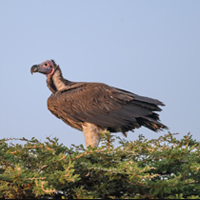

The Lappet-faced Vulture is a massive, powerful scavenger of Africa’s arid savannas, known for its huge, hooked beak, bare pink head with distinctive fleshy folds (lappets), and dominant role at carcasses. As Africa’s largest vulture, it uses its formidable size and strength to tear open tough hides and tendons, allowing smaller scavengers access to food and playing a crucial role in the ecosystem’s clean-up crew.
Key Characteristics:
- Appearance: Enormous size with dark brown to black body plumage and contrasting white thigh feathers (“leggings”). The large, naked head is pinkish with prominent fleshy folds (lappets) on the sides. Massive, pale beak.
- Senses: Exceptional eyesight for locating carcasses from great heights. While it may use scent, its eyesight is its primary tool for scavenging.
- Movement: Powerful, soaring flight on broad, long wings. Strong on the ground, often dominant and aggressive at kill sites.
- Diet: Obligate scavenger (strictly carrion). Prefers large carcasses of mammals like wildebeest or zebra. Its powerful beak is specialized for shearing tough skin, ligaments, and tendons that other vultures cannot break.
- Behavior: Solitary or in pairs, only gathering at large carcasses. Highly aggressive and dominant over all other African vultures. Builds enormous stick nests in the tops of flat-topped trees like acacias.
- Habitat: Arid and semi-arid regions of Sub-Saharan Africa, particularly in savannas, deserts, and open, dry woodlands.