
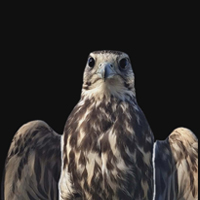

The Saker Falcon is a large, powerful falcon of the open steppes and deserts of Eurasia, renowned for its great speed, endurance in horizontal flight, and status as a traditional bird of falconry. With a robust build and variable plumage from dark brown to pale sandy, it is a formidable hunter of ground-dwelling prey, often taken in a low, swift pursuit over open terrain.
Key Characteristics:
- Appearance: Large, stocky falcon with broad-based, pointed wings. Plumage is highly variable, ranging from dark brown with heavy streaking to very pale sandy-brown with minimal markings. Adults typically show a pale crown and a dark “mustache” stripe, though less contrasting than the Peregrine’s.
- Senses: Possesses extremely acute vision for detecting prey from long distances across flat, open landscapes. Its eyesight is adapted for spotting movement on the ground.
- Movement: Known for its powerful, sustained horizontal flight speed and stamina, rather than the vertical stoop of the Peregrine. Often hunts by low, fast flight or a high, shallow dive, striking prey on the ground.
- Diet: Carnivore, specializing in medium-sized mammals (ground squirrels, susliks, pikas) and birds (up to the size of ducks and pheasants). A classic “desert falcon” adapted to open-country prey.
- Behavior: Diurnal, often solitary or in pairs. Highly prized in falconry for millennia, especially in the Arab world for hunting houbara bustards. Nests on cliffs, old crow nests, or on the ground in remote areas.
- Habitat: Breeds in open grasslands, steppes, semi-deserts, and plateaus from Eastern Europe across Central Asia. Migratory or dispersive, wintering in similar open habitats to the south, including parts of Africa and the Middle East.