
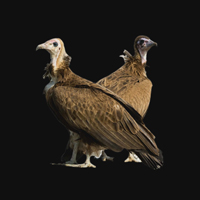

The Hooded Vulture is a small, slender vulture of sub-Saharan Africa, known for its distinctive bare, pinkish face and “hood” of feathers on the crown. It is a critically endangered scavenger that relies heavily on its keen eyesight to locate small scraps of carrion and other waste, often feeding in loose groups and playing a vital role in ecosystem cleanup.
Key Characteristics:
- Appearance: Small for a vulture, with uniformly dark brown plumage. Named for its thin, downy “hood” of feathers on the head. The face and neck are bare, showing pink to bluish skin, which flushes red when agitated.
- Senses: Excellent eyesight for spotting carcasses from high altitudes, but has a weaker sense of smell. Its slender beak is adapted for picking small bits of meat from hard-to-reach places.
- Movement: Strong, soaring flight on broad wings. Often one of the first vultures at a carcass but easily displaced by larger, more aggressive species.
- Diet: Obligate scavenger (strictly carrion). Feeds primarily on small scraps of meat, skin, and tendons left by larger scavengers, as well as insects, waste from human settlements, and even feces.
- Behavior: Often seen alone, in pairs, or in loose groups. More tolerant of human activity than many vultures. Nests solitarily in tall trees.
- Habitat: Widespread across sub-Saharan Africa. Found in a variety of open habitats, including savannas, woodlands, and forest edges, but now heavily reliant on areas near human habitation, including towns and slaughterhouses.